
Laundry rooms, gyms, playrooms and storage
Basement Floor Epoxy in Pittsburgh, PA
A sealed, easy-to-clean basement floor, planned around what your slab's moisture test tells us.
- Free on-site estimates
- Every slab gets a moisture reading before we coat it
- Written quotes that spell out the surface prep
Making Old Basement Concrete Usable
Basement floor epoxy in Pittsburgh starts with an honest look at the slab. Many houses here are old, and some North Side neighborhoods still hold well-kept homes from the 1800s. Their basement floors can be thin, patched and poured with nothing beneath to stop ground moisture. A basement floor coating seals that dusty concrete and turns it into a bright, washable surface for a laundry room, home gym, playroom or workshop, but only once the vapor rising through the concrete has been measured and dealt with.
Why moisture testing comes first
Concrete below grade is in contact with damp soil, and vapor moves up through it all the time. Pittsburgh's average relative humidity is about 68%, and the cool basement slab can also gather condensation from humid summer air. If a coating goes over a slab that is pushing out too much moisture, pressure builds underneath and the floor bubbles, turns white or peels. We test every basement before quoting, using the method the slab calls for, and we record the readings in the quote. High readings mean a moisture-tolerant primer. Liquid water means something else needs fixing before any coating.
Rain, rivers and wet years
The region has a long history of high water. The remnants of Hurricane Ivan in September 2004 flooded about 4,000 homes in Allegheny County, according to WPXI, and 2018 was Pittsburgh's wettest year on record. Basements that took on water then may show staining, efflorescence or old patches. A coating can cover a slab that once flooded and has since dried and been repaired, but it cannot hold back water that is still coming through walls or cracks. If we see active leaks, we tell you to deal with drainage, grading or waterproofing first.
Test for radon before you finish the room
The Allegheny County Health Department notes that up to 40% of Pennsylvania homes may exceed the EPA radon action level of 4 picocuries per liter. Coating a floor does nothing to mitigate radon, and it does not replace a proper system. If you are turning the basement into living space, test for radon first. Should the results call for mitigation, have that system installed before we coat, so the suction point and any sealed cracks are in place and the new floor goes in around them.
What the prep looks like in an old basement
Old basement floors often have a weak, dusty top layer, paint from decades ago, adhesive from old tile or carpet, and cracks that run between the walls. We diamond grind to clean concrete with dust-controlled equipment, fill cracks and low spots, and work carefully around floor drains, sump pits, support posts and the base of the walls. Paint or mastic that might contain old materials is checked before any grinding, and we explain in writing how we plan to handle it.
Choosing a finish
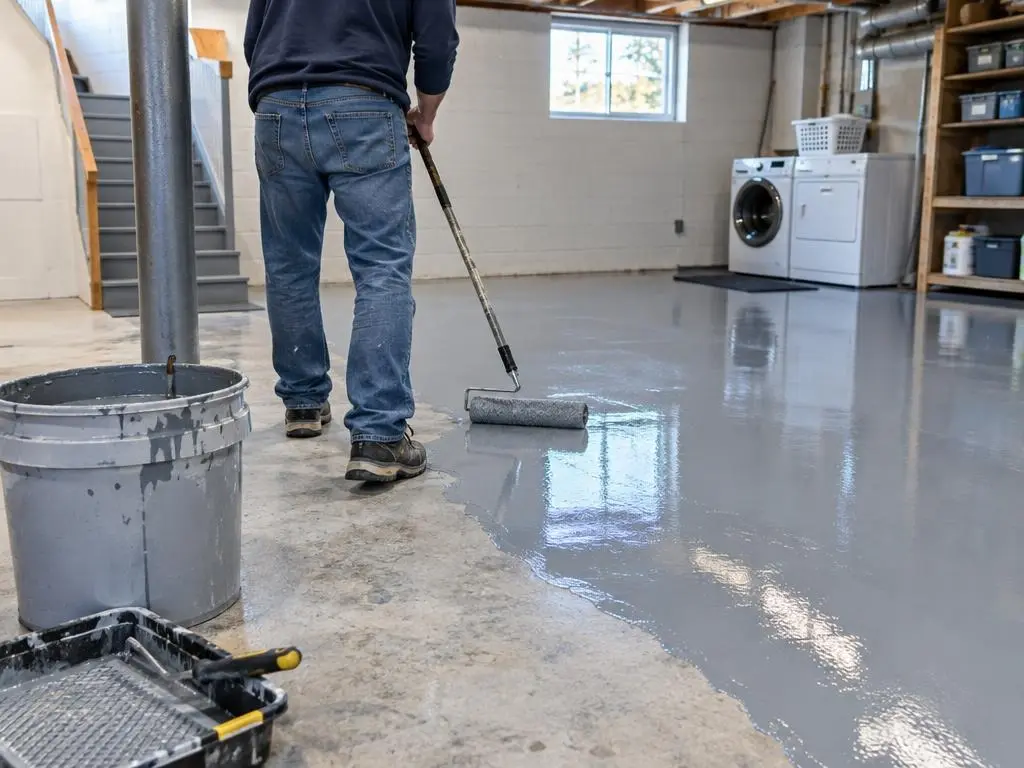
Most basements benefit from a light color. A light gray or tan epoxy, or a partial flake broadcast over a light base, bounces lamp and window light around a room that never gets much sun. A full flake floor hides dust and makes sense in workshops and storage areas. A metallic finish suits a finished basement bar or theater. In laundry rooms and around the sump, grit goes into the topcoat so wet spots stay walkable.
Living with the new floor
A coated basement floor stops concrete dust, sweeps clean and wipes up spills in seconds. Damp mop it with a neutral cleaner, put felt pads on furniture and avoid dragging heavy appliances across it. If a section is ever damaged by a dropped tool or water event, it can be ground and recoated without redoing the whole room. Call (412) 332-8291 and tell us what you want the basement to become. Get a free estimate
What a Basement Coating Covers
We plan basement work around the slab's moisture readings and the room's use.
Moisture testing
Readings taken and recorded before we quote, so the primer matches the slab.
Moisture-tolerant primer
A primer built for slabs that release more vapor than a standard coating can handle.
Crack and low-spot repair
Cracks and dips filled and ground flat before coating.
Old paint and adhesive removal
Old paint, tile mastic or carpet glue ground off after it is checked.
Work around drains and sumps
Careful edges at floor drains, sump pits, posts and wall bases.
Light colors and partial flake
Finishes that brighten a room with little daylight.
Anti-slip topcoat
Grit added for laundry rooms and areas that can get wet.
Typical Basement Floor Coating Costs
| Floor or item | Published range | Source |
|---|---|---|
| Installed epoxy, per square foot | $4 to $10 | HomeGuide |
| Small room, 100 to 200 sq ft, epoxy | $400 to $2,000 | HomeGuide |
| Polyaspartic, 500 square feet | $2,500 to $6,000 | HomeGuide |
| Polyaspartic, 600 square feet | $3,000 to $7,200 | HomeGuide |
| Patching cracks and chips | $25 to $250 | This Old House |
| DIY epoxy kits, material only | $200 to $700 | HomeGuide |
National ranges from HomeGuide and This Old House. Basements vary a lot: moisture-tolerant primers, old paint or mastic removal and crack repair can all move the total. After the moisture test we write up your price, and that written number is what you will pay.
How a Basement Floor Gets Coated
1. Visit and test
We look at the floor, walls, drains and sump, and test the slab for moisture.
2. Written plan
Readings, prep, primer, coats and price are written into the quote.
3. Clear and grind
The room is cleared, old coverings checked and removed, and the slab is ground with dust control.
4. Repair and prime
Cracks and low spots are filled, then the primer chosen for your readings goes down.
5. Color and topcoat
Base color, optional flake and a topcoat with grit where needed, then cure times.
Why Choose Us for Basement Floor Epoxy
Readings in your quote
You see the moisture numbers that shaped the system we picked.
Straight answers about water
If a coating will not solve the problem, we tell you before you pay for one.
Radon-aware scheduling
We coat after any mitigation work so the floor goes in around it.
Dust-controlled grinding
Vacuum-extracted equipment for work inside an occupied house.
Basement Floor Epoxy Questions
How do you test a basement floor for moisture?
We use a test suited to the slab, such as a moisture meter or a timed test under a sealed cover, and record the results in your quote. The readings decide whether a standard or moisture-tolerant primer goes down.
Can you coat a basement that flooded in the past?
Yes, if the slab has dried out and the source of the water has been fixed. If water still comes in, that has to be addressed first.
Will epoxy stop radon in my basement?
No. A coating is not radon mitigation. Test first, and if levels are high, have a mitigation system installed before the floor is coated.
My basement floor is painted. Can you coat over it?
We grind the paint off first. Old paint often has a weak bond, and any coating over it would only be as strong as that paint.
What color works in a basement?
Light grays and tans, or a partial flake over a light base, brighten a room that gets little daylight. Full flake hides dust in workshops and storage areas.
Basement Floor Epoxy Service Areas
- Epoxy Flooring in Pittsburgh, PA
- Epoxy Flooring in Mt. Lebanon, PA
- Epoxy Flooring in Bethel Park, PA
- Epoxy Flooring in Upper St. Clair, PA
- Epoxy Flooring in Monroeville, PA
- Epoxy Flooring in Penn Hills, PA
- Epoxy Flooring in Ross Township, PA
- Epoxy Flooring in McCandless, PA
- Epoxy Flooring in Cranberry Township, PA
- Epoxy Flooring in Pine Township, PA
- Epoxy Flooring in Moon Township, PA
- Epoxy Flooring in Robinson Township, PA
- Epoxy Flooring in Bridgeville, PA
- Epoxy Flooring in South Park Township, PA
- Epoxy Flooring in Plum, PA
- Epoxy Flooring in Murrysville, PA
- Epoxy Flooring in Fox Chapel, PA
- Epoxy Flooring in Shaler Township, PA
- Epoxy Flooring in Baldwin, PA
- Epoxy Flooring in West Mifflin, PA
- Epoxy Flooring in McKeesport, PA
- Epoxy Flooring in Bellevue, PA
- Epoxy Flooring in Canonsburg, PA
- Epoxy Flooring in Peters Township, PA
Get a Basement Floor Epoxy Estimate
Book a free basement floor visit, moisture reading included, in Pittsburgh or a nearby town.